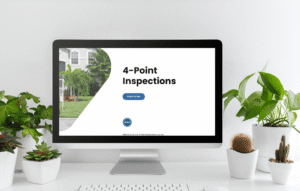
Real estate agents and home inspectors depend on each other for referrals, but agents aren’t always familiar with how inspections work. That gap can make agents nervous that a detailed report will unsettle buyers or slow a closing. ASHI developed this course to fill it.
Every lesson was written from the agent’s point of view, covering what inspectors are required to examine, how findings are documented, and where the scope ends, so agents could prepare clients and move through the inspection conversation with confidence.
The following reflects how the course came together, from early design thinking through the final deliverables.
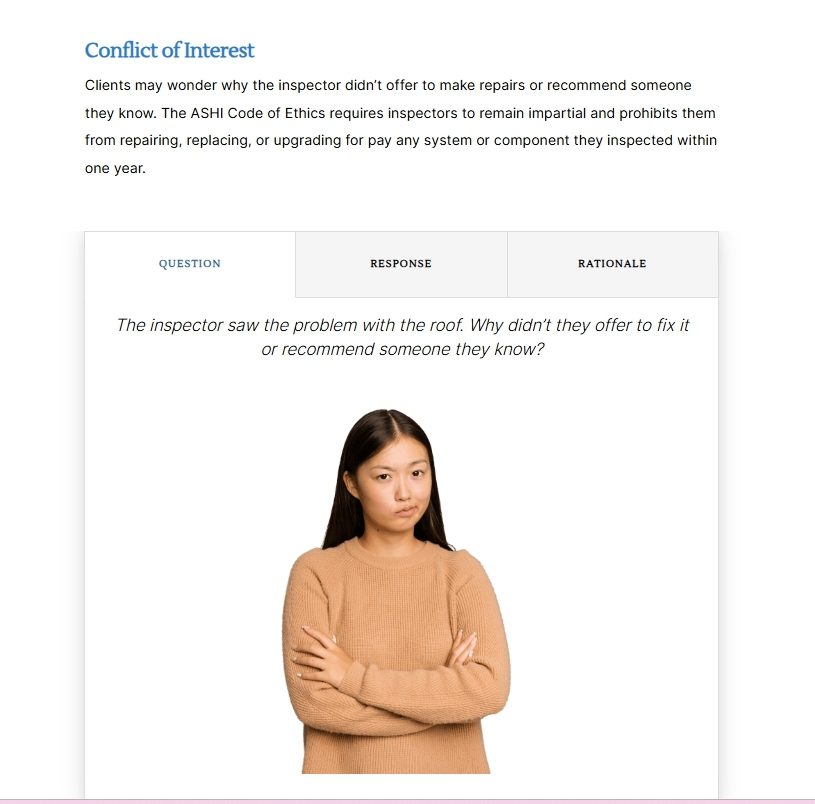
Instead of listing “correct” phrases, the lesson uses real client questions paired with a modeled response and a brief rationale showing how that response aligns with the Standard of Practice.
The questions reflect what agents hear most: anxiety about long reports, expectations that inspectors will price repairs or predict failures, and confusion when inspectors avoid recommending specific contractors.
Providing the rationale alongside the response serves two purposes: it gives agents language they can use immediately, and it builds the underlying understanding that allows them to adapt that language to situations the course doesn’t explicitly cover.
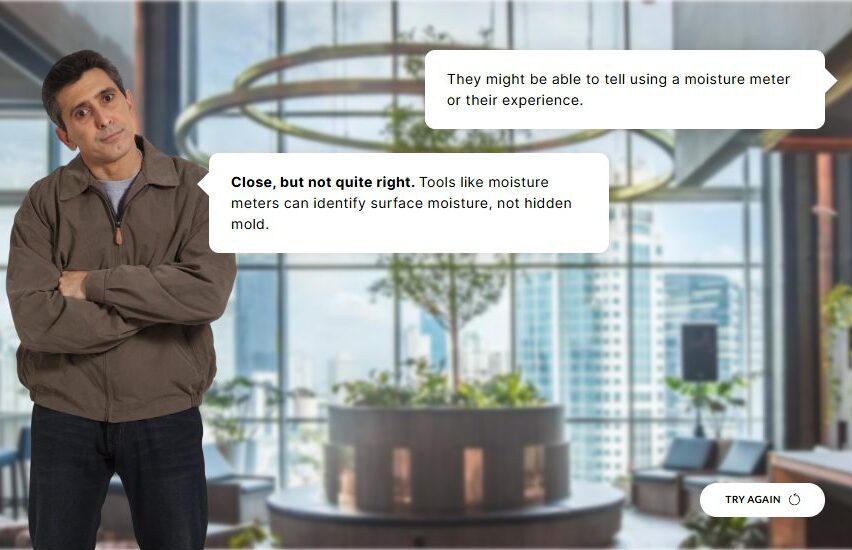
Lesson 4.2 is where the instructional strategy shifts from knowledge to judgment. After working through the client conversation models in 4.1, learners step into a scenario where they have to choose how to respond to a buyer who has just received an inspection report and has questions.
The scenario is not testing recall. It is testing whether learners can apply SoP-aligned language under the kind of pressure that exists in a real post-inspection conversation: a client who is anxious, asking fast questions, and looking to the agent for certainty. Each choice leads to a different outcome, making the consequences of imprecise language visible rather than abstract.
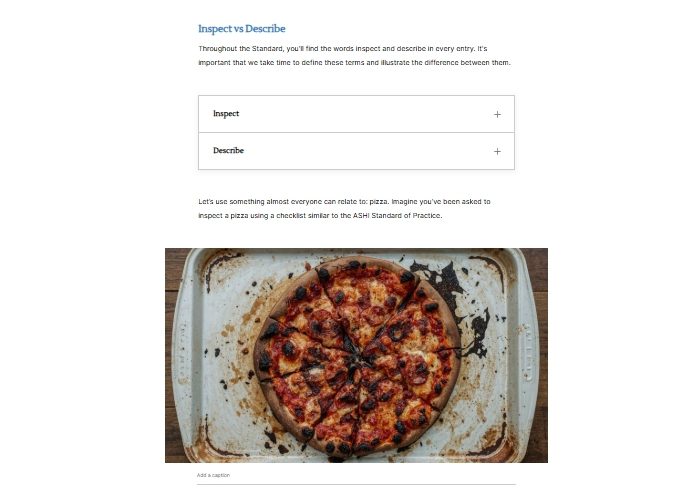
The ASHI Standard of Practice uses two distinct terms throughout: inspect and describe. They are not interchangeable, and misreading them leads to misreading the entire scope of an inspection. Before learners encounter those terms applied across ten home systems, they need a clean mental model of the difference.
The course builds that model through a familiar object with zero stakes: pizza. Learners work through a mock inspection checklist structured exactly like the SoP, observing what is visible, noting deficiencies, and describing components by type without evaluating them.
The analogy works because it isolates the concept from the content load. By the time learners move into the actual home systems, the inspect/describe distinction is already in place and does not have to be learned at the same time as the material.
Learner survey results reflect strong reception across every measured dimension.
The course performance led directly to a commissioned follow-on series, extending the instructional approach to additional topics within the ASHI professional development curriculum.
We use cookies to improve your experience on our site. By using our site, you consent to cookies.
Manage your cookie preferences below:
Essential cookies enable basic functions and are necessary for the proper function of the website.
These cookies are needed for adding comments on this website.
You can find more information in our Cookie Policy and .